
The Final Destination of Mitsubishi Mahindra Agricultural Machinery
1、 The end of an era
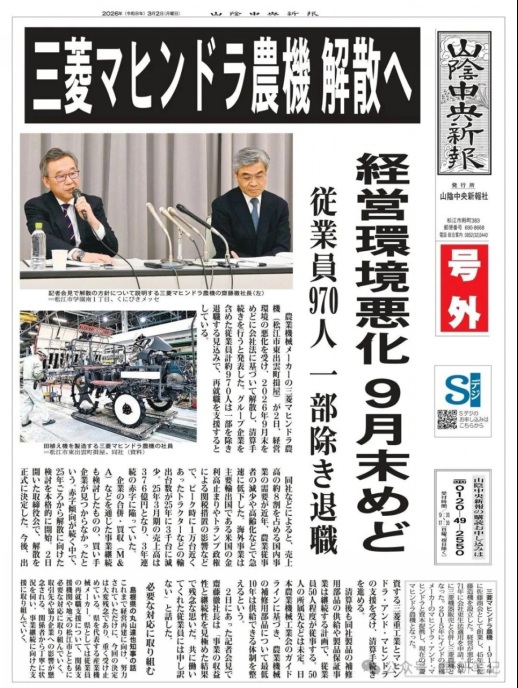
On March 21, 2026, the Japanese newspaper "San'in Chuo Shimbun" published a rare exception in the afternoon. The prominent bold font reads: 'Mitsubishi Mahindra Agricultural Machinery disbands'. In the context of local media in Japan, 'extra' means sudden, significant, and even epoch-making events. For the old factory in Matsue City, Shimane Prefecture, this day is undoubtedly historic: a farm machinery brand that spans 112 years has finally reached the end of its life.
According to the information disclosed in the notice and company announcement, Mitsubishi Mahindra Agricultural Machinery (MAM) will cease production in April 2026, terminate its sales business at the end of September, and officially enter the dissolution and liquidation process in October. Most of the current 970 employees in the company will be laid off, leaving only about 50 to maintain their parts supply and after-sales obligations for the next decade.
The collapse of a century old brand is never an isolated event. It often signifies the end of an industrial cycle and heralds the formation of a new industrial logic.
2、 The trajectory of facts: decline is not accidental, but a structural inevitability
To understand the ultimate outcome of Mitsubishi Mahindra Agricultural Machinery, we must start from facts. All publicly available data points in a clear direction: this is not a management mistake or a failure of market competition, but the result of the combined effects of a country's agricultural structure, global industrial landscape, and technological paradigm.
The White Paper on Agricultural Structure by the Japanese Ministry of Agriculture, Forestry and Fisheries (MAFF) shows that the agricultural population in Japan has sharply decreased from 5.2 million to approximately 1.2 million over the past 40 years, with an average age of over 67 years old. The renewal cycle of agricultural machinery has also been extended from 10-12 years to 15-20 years. For an agricultural machinery enterprise that heavily relies on local paddy field agriculture, such a market structure almost means "chronic death".
Financial data further reveals the company's difficulties. The sales revenue of Mitsubishi Mahindra Farm Machinery has been declining from its peak of 86.2 billion yen in 1995 to only 37.6 billion yen in the 2024 fiscal year; Net loss reached 4.1 billion yen; The sales cost rate is as high as 88%; The net assets are -2.5 billion yen, which is already insolvent. The business activities of the enterprise are no longer able to support its own operation.
More decisive was the cross-border alliance with Mahindra&Mahindra in India in 2015. At first, this was seen as an opportunity for Mitsubishi to move towards globalization, but the reality has turned in the opposite direction. CEO Anish Shah of Mahindra explicitly stated at the 2023 earnings conference that capital must be invested in businesses that can generate 18% ROE. With the successful mass production of the global platform "OJA" jointly developed by both parties in India, Mahindra has already obtained the core technology it needs, so there is naturally no reason to continue to inject blood into the Japanese factory.
The chaos in the supply chain becomes the last straw that crushes the enterprise. In 2024, the Japan Fair Trade Commission (JFTC) issued a penalty notice, stating that Mitsubishi Mahindra Agricultural Machinery had long required subcontracting companies to keep about 9000 molds for free, violating the "Application Law". This means that the supply chain management of the enterprise has fallen into a state of disorder.
All these facts together constitute the "death logic" of Mitsubishi Mahindra Agricultural Machinery: market contraction, financial deterioration, capital withdrawal, supply chain loss of control, and ultimately leading to an irreversible end.
3、 Deep logic: Mitsubishi's failure is a systematic collapse of triple mismatch
If Mitsubishi's failure is solely attributed to poor management, it would be unfair to this century old enterprise. The real reason is deeper, more structural, and more worthy of warning to the Chinese agricultural machinery industry.
Firstly, there is a mismatch in the market. Mitsubishi's technological advantage lies in its miniaturization and precision, especially suitable for the narrow, muddy, and complex working environment of Japanese paddy fields. However, the demands of the global mainstream agricultural machinery market are completely different: large-scale, heavy-duty, dryland, and intelligent. Mitsubishi's technological depth has instead become an obstacle to its global expansion. Its products have almost no competitiveness in the vast dryland markets such as Europe, America, South Asia, and Africa, and this "technological isolation" ultimately makes the enterprise lose the possibility of globalization.
Secondly, there is a mismatch of capital. The investment logic of Mazda is very clear: capital must be invested in high return businesses. Mitsubishi Heavy Industries' strategic focus has also shifted to high profit areas such as defense equipment, decarbonization technology, and data centers. The agricultural machinery business is neither profitable nor has strategic synergy, making it a natural target for abandonment. Moreover, any potential acquirer must bear the severance pay for 900 employees and a ten-year warranty obligation, which makes the actual value of the enterprise negative. In the modern capital system, such enterprises have almost no room for survival.
Thirdly, there is a mismatch in technological paradigms. The global agricultural machinery industry is undergoing a profound technological leap: from mechanical manufacturing to intelligent platforms, from single machine equipment to system ecology, and from hardware competition to software and data competition. Autonomous driving, sensor fusion, machine operating systems (Machine OS), and data closed-loop agriculture are becoming new industry standards. Mitsubishi's market share is only 5%, and its size is not enough to support intelligent research and development, nor can it build system capabilities. In the transition of technological paradigms, it has been left behind by the times.
These three mismatches together constitute the systematic failure of Mitsubishi Mahindra agricultural machinery. It is not defeated by competitors, but eliminated by the times.
4、 Inspiration for China's agricultural machinery industry: four structural issues that must be faced directly
The collapse of Mitsubishi is not a problem for Japan, but a landmark event in the global transformation of the agricultural machinery industry. For the Chinese agricultural machinery industry, it provides four systematic warnings that must be taken seriously.
Firstly, Chinese agricultural machinery enterprises must overcome the "single domestic demand dependence". One of the fundamental reasons for the decline of Japan's agricultural machinery industry is excessive reliance on the domestic market. Kubota is able to maintain stability because its overseas sales account for as much as 70%. Although Chinese agricultural machinery enterprises rely on the huge domestic market, with the changes in agricultural population structure and the promotion of urbanization, the domestic market will gradually enter stock competition. The real way out lies in globalization, but globalization cannot stop at "selling products", and must move towards a deep layout of "localized development+channel construction+service system".
Secondly, China's agricultural machinery technology must avoid "islanding". The reason why Mitsubishi's technology is ineffective is that it is overly adapted to Japanese paddy fields and cannot adapt to mainstream global operating scenarios. Chinese agricultural machinery enterprises also face similar risks: hills, small plots, and regional operation modes can easily make the technological path closed. The underlying design of the future must be modular, platformized, and globalized. Only with global universality can technology have vitality.
Thirdly, scale will become the "ticket" to the era of intelligence. The cost of intelligent research and development is extremely high, involving multiple fields such as software, sensors, algorithms, and data platforms. Without sufficient market size, it is impossible to afford long-term research and development investment. Mitsubishi's 5% market share is not enough to support intelligent transformation. Chinese agricultural machinery enterprises must do large-scale through mergers and acquisitions, cross-border cooperation, and other means, otherwise it will be difficult to stand firm in the future intelligent competition.
Finally, production capacity and channels must be dynamically adjusted. When Mitsubishi's sales fell to 37.6 billion yen, it still maintained a large network of factories and distributors, resulting in a sales cost ratio of up to 88%, and the more it sold, the more it lost. The Chinese agricultural machinery industry also faces problems of channel redundancy and overcapacity. Fixed costs are the hidden killer of agricultural machinery enterprises and must maintain flexibility in strategy.
5、 Reminder to Chinese Farmers and Cooperatives
The collapse of Mitsubishi also brought important inspiration to farmers. Agricultural machinery is a heavy asset investment with a lifecycle of over ten or even decades. When purchasing a machine, one should not only consider the price, but also the long-term survival ability and market share of the enterprise. The risk of relying on a single manufacturer's "unique" special models is extremely high. Once the enterprise goes bankrupt, maintenance and parts supply will become a huge burden. Farmers and cooperatives should establish independent maintenance capabilities or establish long-term cooperative relationships with reliable socialized maintenance forces to ensure production safety.
6、 Conclusion: The end of one era is also the beginning of another era
The finale of Mitsubishi Mahindra Agricultural Machinery is the end of a century old brand and a symbol of the global agricultural machinery industry entering the era of "system capability competition". The competition in the future is no longer about horsepower, but about systems; It is no longer a competition of individual machines, but a competition of platforms; It's no longer a price competition, but an ecological competition.
For Chinese agricultural machinery enterprises, this is not only a rare window period, but also a life and death test that must be taken seriously. Whoever can build true system capabilities in the wave of globalization, platformization, and intelligence will be able to occupy a place in the future agricultural machinery industry landscape.
Reference materials (classified by source)
1、 Japanese media and news reports
On March 21, 2026, the Shanyin Central News reported that Mitsubishi Mahindra Agricultural Machinery will be dissolved in 2026, including core information such as production stoppage, sales stoppage, and number of employees.
O Nihon Keizai Shimbun's enterprise report (2023 – 2025) involves Japan's agricultural machinery market share, Mitsubishi Mahinda's agricultural machinery financial situation, industry competition pattern, etc.
NHK Agriculture Special Report (2024-2025) discusses concerns among paper film rice transplanters and organic agriculture farmers about the discontinuation of Mitsubishi products.
The reports from Asahi Shimbun and Mainichi Shimbun (2024-2026) involve the deterioration of Mitsubishi Mahindra's agricultural machinery operations, supply chain issues, and local economic impacts.
2、 Information on the Japanese government and regulatory agencies
The White Paper on Agricultural Structure by the Japanese Ministry of Agriculture, Forestry and Fisheries (MAFF): Historical Data on Changes in Agricultural Population (1985-2025), Average Age of Agricultural Practitioners, and Changes in Agricultural Machinery Renewal Cycle
Japan Fair Trade Commission (JFTC) Penalty Announcement (November 2024) Mitsubishi Mahindra Agricultural Machinery violated the "Application Law" by requiring subcontracting companies to keep approximately 9000 molds for free
3、 Corporate financial report and official release
Mitsubishi Mahindra Agricultural Machinery (MAM) Financial Report (2023-2025) Sales (37.6 billion yen), Net Loss (4.1 billion yen), Cost of Sales Ratio (88%), Net Assets (-2.5 billion yen)
Mahindra&Mahindra CEO Anish Shah's statement on capital discipline stating that 'ROE must reach 18%' at the 2023 financial report briefing, OJA Global Platform production information
Kubota's 2024 financial report shows that overseas sales account for over 70% of the global market layout
Mitsubishi Heavy Industries (MHI) Strategic Statement (2023-2025): The strategic focus is shifting towards high profit areas such as defense, decarbonization, and data centers, and the agricultural machinery business is no longer part of the strategic sector
4、 Industry research and public information
Analysis of Japanese Agricultural Machinery Market Share (Nikkei, Yano Economic Research Institute) Kubota about 35%, Yangmayo 25%, Mitsubishi about 5%
Mahindra OJA Platform Technical Data (2023) Developed with the participation of the Japan Technical Center (formerly Mitsubishi R&D team) to position products for the global market
The history and application of paper film rice transplanters (paper planting machines) and the dependence of organic rice on Mitsubishi models in JA Agricultural Association and local agricultural organizations
5、 Historical data and corporate history
Mitsubishi Agricultural Machinery History Data (Corporate History, Local Chronicles) Founded in 1914 as the "Sato Chamber of Commerce", it merged with Mitsubishi Machinery Sales in 1980 and achieved sales of 86.2 billion yen in 1995
O Historical Data on Local Industries in Japan (Matsue City, Shimane Prefecture): The Long term Impact of Mitsubishi Farm Machinery Factory on Local Economy and the Impact of Industrial Decline on Local Employment
Conclusion
Mitsubishi's downfall marks the global agricultural machinery industry entering an era of system capability competition - no longer a battle over horsepower or price, but a battle between platforms and ecology. For Chinese companies, this is a rare window of opportunity and a life and death test. Whoever can build global and intelligent system capabilities will be able to occupy a place in the next round of industrial landscape.