
Why are tractors getting bigger and bigger
1、 Growing tractors
The world's first commercially sold agricultural gasoline tractor was produced by the Hartlepool Tractor Factory in the United States, with a horsepower of approximately 17-33 horsepower. Due to the output power of the tractor rod being 17 horsepower and the wheel output power being 33 horsepower, the tractor was named the 17-30 type.
Subsequently, tractors began to be widely commercialized in European and American countries. During this period, although some Japanese companies launched small tractors with only a few horsepower, overall, the power of tractors continued to climb, seemingly endless.
The most famous high-powered tractor in the world is the Big Bud 747, manufactured by Northern Manufacturing Company in Havre, Montana in 1977. It boasts impressive functionality and appearance, and is equipped with a 16 cylinder Detroit diesel engine that can produce 760 horsepower, making it the most powerful tractor at the time.
Until today, the Big Bud 747 is still in service and remains one of the world's most powerful tractors, but it is no longer sufficient in terms of horsepower because tractors with higher horsepower than the Big Bud 747 have emerged one after another.
In 2024, John Deere launched the 9RX 830 heavy-duty tractor with a power of 830 horsepower; In the same year, Germany's Fantawild launched the Fantawild 1100 Vario MT series, consisting of three models with a maximum horsepower of 673; In September 2025, at the 72nd Agricultural Progress Exhibition held in Decatur, Illinois, USA, Case New Holland launched the Steiger 785 Quadtrac, with a rated power of 785 horsepower and a peak horsepower of 853 horsepower, making it the largest tractor in the Case New Holland Group.
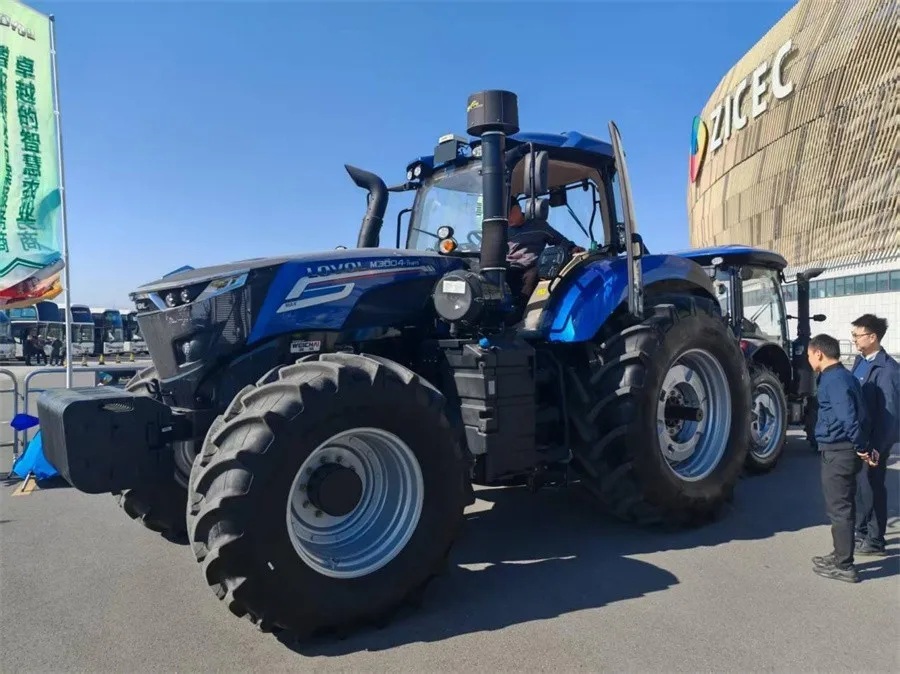
When it comes to high-powered tractors, domestic brands are no less impressive. In recent years, the power of domestic tractors has continued to increase, and among tractor products with 25 horsepower or more, the proportion of models with 200 horsepower or more is increasing.
The trend of domestic tractors developing towards high power is very obvious, and it presents a trend of three technological routes advancing simultaneously:
One is the large-scale shifting of meshing sleeves and synchronizers. Experts believe that for tractors with over 200 horsepower, the engagement sleeve and synchronizer do not have advantages in performance and cost-effectiveness, so it is necessary to develop power switching, power shifting, and CVT technology. However, some domestic brands have not followed this viewpoint. Around 2023, companies such as Shandong Yijia and Luoyang Lanming scaled up and developed a 380 horsepower heavy-duty tractor based on the Dongfanghong Fiat chassis in the same proportion. This model has shown good operational performance and ultra-high cost-effectiveness. However, if synchronizer technology wants to further improve, it seems to face numerous difficulties.
The second is power shifting CVT。 In 2023, Yituo launched the LW4004 continuously variable transmission tractor, and in September 2025, Haodi Technology launched a 400 horsepower full power shift tractor, which is the largest CVT and power shift tractor in China.
The third is electric and hybrid. In 2024, Zhongke Original Power launched a 260 horsepower pure electric tractor, claiming to be the world's largest horsepower pure electric tractor.
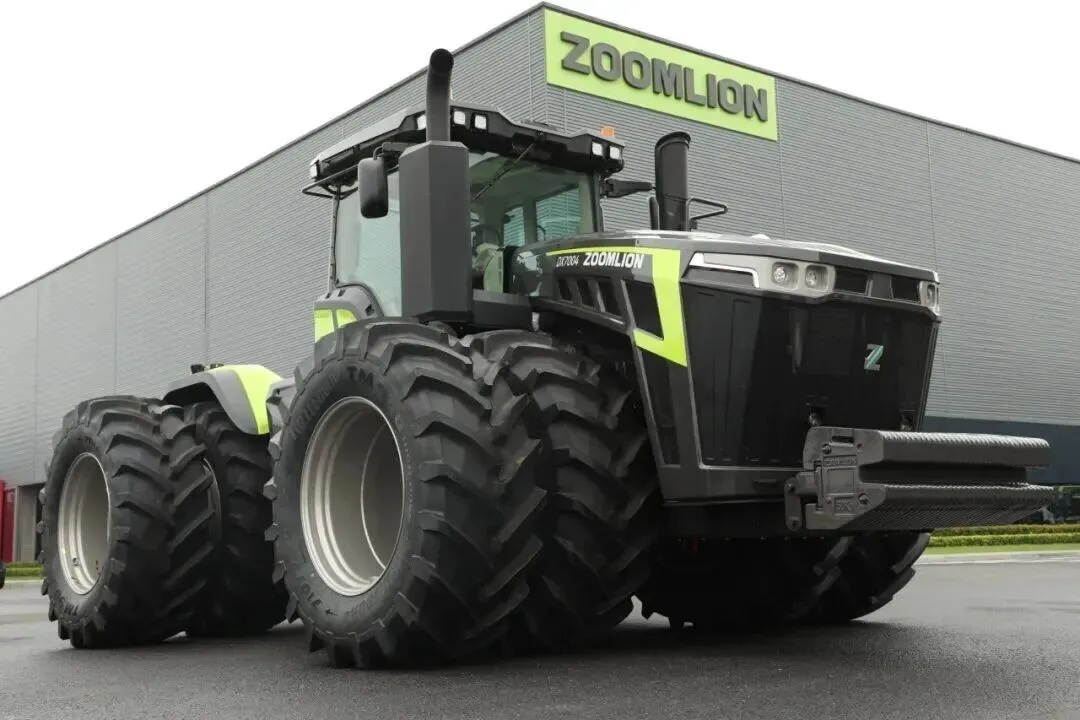
On October 15, 2024, Lingong Agricultural Machinery launched the X6004-9E hybrid tractor, which adopts a series structure and is known as the world's largest hybrid tractor. After a year, on September 17, 2025, Zoomlion held a new product launch event and announced that it had produced the world's most powerful DX7004 hybrid tractor. The machine adopts a hybrid structure, with dual motors rated at 700 horsepower, peak power of 1200 horsepower, peak torque of 4500 Newton meters, and a continuous operating area of 7200 acres in 2 hours.
The author believes that tractors, as the power platform for thousands of agricultural machinery, will not change their trend of power upgrades in the future. It is expected that there will be even more powerful tractors in the future. With the trend of increasing power, power upgrades seem to have no end.
2、 Why are tractors getting bigger and bigger?
The core reason why global tractor companies are launching increasingly powerful models is due to the structural changes occurring simultaneously in the four aspects of "land labor technology policy", rather than a simple "parameter competition". Based on the latest industry research and technology roadmap analysis, it can be summarized into five points:
1. The average area of the farm is rapidly expanding
The increasing power of tractors and combine harvesters worldwide is directly driven by the expansion of agricultural machinery operating areas and the reduction of labor force.
From a foreign perspective, contiguous farms ranging from 5000 to 20000 hectares have become the norm in Brazil, Russia, Australia, and the Midwest of the United States. Data shows that the number of farms in the United States is continuously decreasing, while the average area of individual farms is steadily expanding. This trend has continued for nearly 90 years and is still accelerating in recent years. According to statistics from the US Department of Agriculture, since the peak of 6.814 million farms in 1935, this number has decreased to about 2.02 million by 2022, a decrease of over 70%. At the same time, the average area of farms has almost doubled from 62.6 hectares (155 acres) in 1935 to 466 acres (approximately 189 hectares) in 2022.
Large scale farms require large-scale deep loosening, joint land preparation, and compound operations to complete multiple processes in one go. Only 300-600 hp level tractors can provide a traction force of over 60 kN and ensure a plowing depth of over 30 cm at operating speeds of 10-15 km/h.
From the domestic situation, the land transfer rate is close to 40%, with a transfer area of about 600 million acres; It is expected that the built-up area of high standard farmland will reach 1.15 billion mu by 2025. The transfer of land and the construction of high standard farmland have promoted the development of large-scale agriculture and the rise of organized users. In addition, the rise of land trusteeship and agricultural service organizations has further promoted the development of large-scale agriculture. And large-scale agriculture will definitely promote the development of tractors towards higher power and efficiency. In recent years, the demand for large and heavy-duty tractors with 200 horsepower and above has been increasing, and their proportion in tractors is increasing.
2. Labor shortage and soaring labor costs
On a global scale, the transfer of population from the primary industry to the secondary and tertiary industries is the norm, and urbanization is also an important trend. Although European and American countries have basically completed urbanization, the trend of rural population transferring to cities remains unchanged, with only differences in speed, proportion, and quantity. Field investigations have shown that the younger generation in large farms in European and American countries, once educated, are unwilling to return to rural life. As social animals, people tend to prefer cities because they provide more opportunities for development and social resources.
The decreasing trend of agricultural population in the United States has been going on for over a century. From 1910 to 1970, the agricultural population sharply declined, and the population structure completed the transition from agricultural population to industrial population. For example, in 1910, the agricultural population in the United States accounted for 35% of the total population, but by 1970, this proportion had decreased to 5%. In addition, between 1970 and 1979, the agricultural population further declined, from 5% of the total population to 3%. According to historical data, the agricultural population in the United States was approximately 38 million in 1900, accounting for 40% of the total population. By 1950, this number had reached its peak at around 10 million, accounting for 17% of the total population. In the 21st century, the official statistics of the agricultural population based on the "farmer+long-term employed" caliber in 2020 were 2.42 million, accounting for 1.3% of the total population. If seasonal workers and employees of agricultural service companies are also included, the total agricultural population is about 13.5 million, accounting for about 4% of the total population. The US Department of Agriculture (USDA) predicts that by 2030, the proportion of pure "farm operators" will decrease to below 1%.
Since the reform and opening up, the speed and scale of China's labor force transferring to cities have undergone significant changes. In the early days, over 10 million rural people migrated to cities every year, but in recent years, with the slowdown of urbanization, the speed of transfer has slowed down, and the number of transfers has decreased to millions. Nevertheless, over 5 million rural residents continue to migrate to cities every year. This large-scale population mobility has led to a shortage of rural labor, especially in the field of agricultural production, where the dual shortage of labor quantity and structure is becoming increasingly prominent.
The best solution to the labor shortage is for machines to replace humans. With the improvement of scale, on the one hand, a large number of machines are used for agricultural production, and on the other hand, machines with higher power and efficiency are applied to various aspects of agricultural production. Tractors, as the mother machine of agricultural production, are the power source. In line with the trend of scale, their scale is also increasing.
3、 High standard farmland and land trusteeship
As mentioned earlier, the high standard farmland is particularly emphasized here.
China will build 1.2 billion mu of high standard farmland by 2025, and is promoting the implementation of large-scale conservation tillage technologies in the Northeast and Central Plains regions. For example, Jilin requires full straw return and VRT variable fertilization, which increases operational resistance by 25% to 40% compared to traditional shallow plowing and requires higher power tractors. In Xinjiang and Heilongjiang regions, land is further concentrated, requiring tractors with higher horsepower to carry more powerful agricultural machinery for operation. Many places are promoting the use of resumption of work machinery, and tractors that used to only require 180 horsepower now require 350 horsepower.
At the same time as land concentration, in order to solve the problem of difficult use of agricultural machinery and serious land abandonment in small-scale agricultural production, the Chinese government is vigorously promoting socialized agricultural services. Land trusteeship and agricultural trusteeship are the main directions. Now, large platform companies with trusteeship areas of tens of thousands or hundreds of thousands of acres have emerged in various places. These professional platform companies are in urgent need of high-powered tractors in the process of large-scale services, and the larger the trusteeship area, the more efficient and powerful tractors are needed.
4、 The demand for "power redundancy" in intelligent and hybrid systems
This is a new phenomenon or demand.
Why did Lingong Group launch a 600 horsepower hybrid tractor? Will Zoomlion launch a 700 horsepower hybrid tractor? Behind this is the demand for "power redundancy". Compared with transmission agricultural machinery, the current demand for electrification of agricultural machinery in China is also urgent. Electric agricultural machinery requires tractors to provide additional mechanical or electrical energy.
The air blown electric drive wide seeder requires the tractor to continuously output a PTO/electric power of 15-25 kW; Hybrid models also need to reserve a power generation margin of 20-30 kW for the battery. The enterprise found that only by achieving a tractor base platform of 350 hp or more can it maintain a "net operating power" of 250 hp even after installing a complete set of intelligent kits.
Of course, electrification technology enables domestic tractor companies to manufacture larger tractors without being limited by precision component processing capabilities.
5、 Policies and subsidies tilt towards' large, high-end '
According to the Implementation Opinions on Subsidies for Agricultural Machinery Purchase and Application in 2024-2026, the upper limit of subsidies for single machines with a capacity of 200 hp or more will be increased to no more than 250000 yuan in the new round of agricultural machinery subsidy policies, which is 30% to 50% higher than the previous policy. In addition, subsidy policies require relevant aircraft models to be equipped with Stage V/National IV or higher emission standards, VTI variable suspension systems, and Beidou/GNSS autonomous driving interfaces. The subsidy leverage has relatively lowered the threshold for large-scale purchases, further stimulating the demand side to "buy big instead of small".
Therefore, the global increase in tractor horsepower is not a gimmick, but an inevitable result of the combination of land scaling, changes in rural labor structure, precision agriculture technology, and policy guidance; With the continuous advancement of agricultural technology, 400 hp and above have become the new "entry-level power" for large farms in Europe, America, and Australia, while the 600 hp hybrid/pure electric concept aircraft is seen as the standard power platform for unmanned farms in 2030.
6、 The means of enterprise competition: Big is strength
High horsepower tractors are known as the jewel in the crown of the agricultural machinery industry, symbolizing the technological strength and industry status of enterprises. For example, top global tractor brands such as Dongfanghong and Lovol Smart Agriculture have demonstrated their competitiveness in the field of agricultural machinery by continuously launching tractors with higher horsepower. These brands' products not only cover a wide power range from 20 to 700 horsepower, but also demonstrate technological innovation and efficient operation capabilities in design and functionality.
Similarly, users also have a similar mentality. For large farmers, owning the most advanced and powerful tractors is also a symbol of success and strength, which to some extent drives market demand.