
Panoramic Observation of China's Agricultural Machinery Industry in 2025
2025 is a crucial year for China's agricultural mechanization to move towards high-quality development. Faced with complex and ever-changing domestic and international environments, frequent extreme weather challenges, and urgent needs for industrial upgrading, the agricultural machinery industry has undergone profound changes in multiple dimensions such as policy guidance, technological innovation, market structure, and export patterns. From the precise adjustment of subsidy mechanisms to the diversified evolution of power systems, from the accelerated landing of high-end intelligent equipment to the historic leap in export proportion, this year not only witnessed the industry's resilience in responding to the "big test", but also outlined a new vision for the modernization of agricultural machinery during the "15th Five Year Plan" period. The following ten observations comprehensively present the transformation trajectory and future direction of China's agricultural machinery industry in 2025.
PART1
Strategic opportunity: The top-level design of the 15th Five Year Plan outlines the panoramic blueprint for upgrading agricultural machinery
On October 28, 2025, the full text of the "Proposal of the Central Committee of the Communist Party of China on Formulating the 15th Five Year Plan for National Economic and Social Development" was released. It is suggested to emphasize the promotion of high-end intelligent and suitable agricultural machinery and equipment research and application in hilly and mountainous areas, and to promote the integration and efficiency improvement of good fields, good seeds, good opportunities, and good methods. Han Jun, Minister of Agriculture and Rural Affairs, published a signed article in the People's Daily and gave clear instructions on the development of agricultural machinery and equipment.
The proposal and the article signed by the minister have brought comprehensive and multi-level development opportunities to the agricultural machinery industry.
Firstly, high-end products such as high-power intelligent agricultural machinery and assisted driving/unmanned driving equipment will usher in a research and development boom, promoting agricultural production towards integrated environmental perception, intelligent decision-making, and autonomous navigation, achieving full process intelligence and unmanned operation in farming, planting, management, and harvesting, effectively improving operational efficiency and accuracy.
Secondly, lightweight, simplified, and multifunctional agricultural machinery suitable for hilly and mountainous areas will be accelerated, effectively solving the problem of regional imbalance in agricultural mechanization development.
Thirdly, "improving green and quality" will become an important development direction for the agricultural machinery industry. Clean energy equipment such as electric and hydrogen energy will develop in parallel with high-efficiency and low consumption internal combustion engines, and the proportion of hybrid new energy will gradually increase.
Fourthly, based on IoT technology to collect agricultural machinery operation data, new service models such as smart farm management and predictive maintenance have emerged, such as providing users with value-added services such as equipment operation and maintenance reminders, job quality monitoring, and yield forecasting.
Fifth, the overall solution for smart agriculture will become a new form of service, integrating intelligent hardware, management software, data analysis, and agricultural services to provide full chain intelligent services from cultivation management to drying and warehousing for large-scale farms and users, promoting the digitization and intelligent management of the entire agricultural production process. During the 15th Five Year Plan period, agricultural machinery will be upgraded from simple operating tools to carriers of full chain digital solutions, and this idea is about to become a reality.
PART2
Guided upgrade: Subsidizing agricultural machinery from "scale coverage" to "precision traction"
The core change of agricultural machinery subsidies in 2025 lies in the upgrading of the design concept of subsidy content. The policy no longer pursues inclusive coverage, but precisely drives industrial upgrading and weak links. This is mainly reflected in two aspects: firstly, the structural "strengthening and expanding the scope" of scrapping and updating subsidies, with the national subsidy for machinery added to 15 categories, focusing on intelligent and post production equipment such as crop protection drones and grain dryers, and increasing the scrapping subsidy standard for key machinery by 50%; Secondly, for the first time, a special subsidy for high-end equipment will be established to address shortcomings. High subsidies and strict technical barriers will be implemented for intelligent tractors with a continuously variable transmission of 200 horsepower or more, directly guiding resources towards core technologies and high-end manufacturing.
PART3
Mechanism reform: Redemption process shifts from "hierarchical approval" to "direct access to fast sharing"
To ensure the efficient implementation of policy dividends, a key breakthrough has been achieved in the mechanism of fund redemption and supervision by 2025. The biggest innovation is the implementation of the "hierarchical distribution" model, where multiple provinces have transferred the authority to distribute subsidy funds from the county level to the provincial or municipal level. Through direct system connection and centralized payment, the intermediate links and disbursement time have been greatly compressed. At the same time, the innovative introduction of the "use first, subsidy later" model in high-end agricultural machinery subsidies will bind the payment with the workload and Beidou data feedback. These two institutional reforms have jointly built a more transparent and traceable "direct access" channel, solving the problem of fund retention from an institutional perspective.
PART4
Capability enhancement: Policy system shifts from "static annual plan" to "dynamic elastic response"
The policy system in 2025 will demonstrate unprecedented flexibility and emergency response capabilities. Its prominent feature is the rapid activation of temporary and specialized emergency subsidies in response to sudden natural disasters. For example, in Shandong, Shaanxi and other places, after encountering rainy and cloudy weather during the autumn harvest, they quickly issued additional subsidies for four types of important equipment, including mobile dryers and crawler harvesters, and prioritized their payment. This marks the evolution of China's agricultural machinery subsidy system from a relatively fixed annual plan to a multi-level support system that can quickly respond to real needs and has "normal+emergency" flexibility, with significantly enhanced policy resilience.
PART5
Diversification of new energy paths: hybrid as mainstream, parallel development of pure electricity and alternative fuels
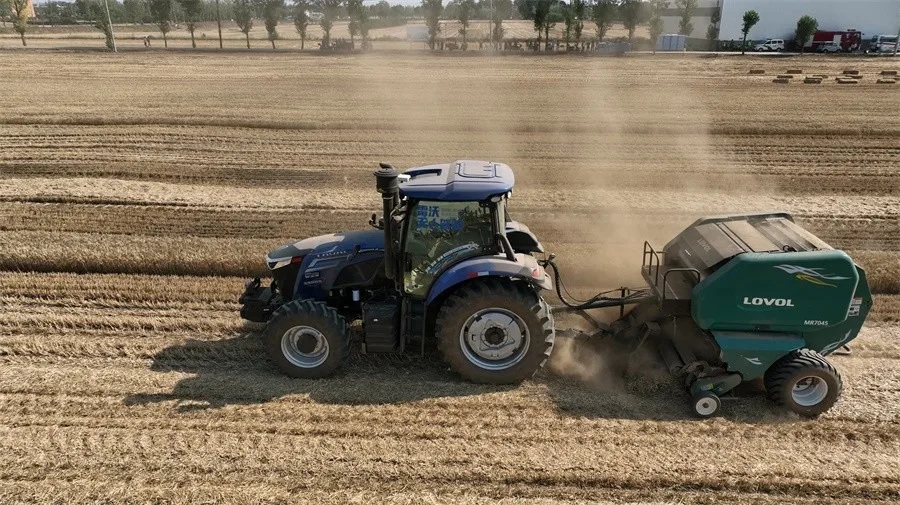
In 2025, the development of new energy in China's tractor industry will present a clear, diverse, and scenario driven new pattern. The mainstream path represented by hybrid power has fully exploded, with leading enterprises such as China Yituo, Weichai Lovol, Dongfeng, and Wode, as well as many newcomers such as Liugong, Zhongnong Boding, and Yingxuan, intensively launching a full range of products from 80 horsepower to 380 horsepower. Through different technological routes such as ECVT and series connection, they have generally achieved fuel saving effects of 10% -30% and significant operational efficiency improvement. Under the dual drive of policy subsidies and economic benefits, they have become the focus of market competition.
At the same time, pure electric technology focuses precisely on specific scenarios such as facility agriculture, modern pastures, and orchards that have strict requirements for noise and emissions. Products from companies such as BYD, Weichai Lovol, Heavy Duty Truck Group, and Zoomlion have demonstrated their mature application in this field.
More cutting-edge is the global breakthrough in alternative fuel technologies represented by Zhongke Yuanli's alcohol hydrogen direct drive tractor and New Holland's methane powered tractor, marking the industry's exploration of higher-level green power solutions.
PART6
The proportion of agricultural machinery exports has risen: accounting for nearly 90% of the total domestic market
In 2025, the agricultural machinery export market has delivered an impressive performance. In the first 11 months, the export value of agricultural machinery and components in China reached 65.837 billion yuan, a year-on-year increase of 28.27%. As of December 19, 2025, the domestic consumption of agricultural machinery subsidies was 74.773 billion yuan, and the export value of agricultural machinery accounted for 88% of the domestic agricultural machinery market, an increase of 20 percentage points compared to last year. The role of agricultural machinery exports in China's agricultural machinery industry is becoming increasingly significant.
In terms of specific categories, mowers, spare parts and spray are still the main export force, accounting for 48% of agricultural machinery exports. The export value of high-value agricultural machinery such as combine harvesters, poultry feeders, cotton harvesters, 100-180 horsepower tractors, and track tractors/tractors has significantly increased, and China's agricultural machinery exports are moving towards high-end development.
PART7
Technological leap: The market for power shift tractors has entered a period of rapid differentiation and growth
In 2025, the market for power shift tractors will enter a period of rapid growth. As of December 19, 2025, the publicly announced sales of subsidies reached 25567 units, exceeding the total of the past five years.
Among them, the power reversing model has the fastest growth, with sales reaching 19980 units, which is 2.9 times the total sales in the past five years. It is popular in the market because it balances efficiency and cost. The sales of Hi Lo two speed power shift models reached 2771 units, an increase of 57% compared to 2024, showing a stable growth trend.
The sales of high-end full power shift and continuously variable transmission (CVT) tractors are relatively small, with 570 and 286 units respectively. These two types of products have a high price threshold and currently mainly meet the needs of large farms or professional users for ultimate efficiency and experience, with limited market growth.
PART8
Structural differentiation: Subsidy data reveals market fluctuations
As of December 19, 2025, the publicly announced sales volume of agricultural machinery subsidies nationwide was 3.0435 million units, with a total invoice amount of 74.773 billion yuan issued by distributors. Compared with the whole year of 2024, both sales volume and amount have declined.
Although the overall scale of the industry has not grown, several sub sectors have shown outstanding performance. Among them, the sales of unmanned aerial vehicles for plant protection reached 104800, with a year-on-year increase of 145%; The sales of field monitoring and operation monitoring equipment exceeded 17000 sets, with an increase of over 90%. In addition, sales of micro tillage machines, threshers and other categories have increased by over 30%, while sales of peanut harvesters and film laying machines have increased by over 20%.
At the same time, the market of some categories has shrunk significantly. The sales of balers, feed shredders, subsoilers and other products have declined by more than 40%, while the sales of spray bar spray and rice transplanters have declined by more than 30%.
PART9
New Industry Trend: Clear Pricing for Agricultural Machinery at the 2025 Autumn Exhibition
In modern trade activities, open quotation and clear pricing are considered basic trade principles. Manufacturers provide clear price labels for everything from airplanes and cars to mobile phones and food. Especially in the current era when the Internet is developed, the public prices of many products can be easily obtained through online search. However, some industries in China have not strictly adhered to this standard, including the agricultural machinery industry. Agricultural machinery manufacturers rarely publicly quote prices, at most only giving a rough price range, and most adopt a "price negotiation" approach.
However, at the 2025 Agricultural Machinery Autumn Conference, Zhongnong Boding, a newly entered player in the agricultural machinery industry, will directly display the market price in a prominent position on each tractor exhibition board. Does this indicate that the agricultural machinery industry will also begin to publicly quote? Let's talk about your viewpoint.
PART10
Encountering two major exams in three years, the shortcomings of grain drying are highlighted
In the summer harvest season of 2023, Henan Province experienced severe weather conditions known as "rotten field rain", which affected 17 provincial cities throughout the province, particularly causing more serious impacts on wheat harvesting work in Zhumadian, Nanyang and other areas. Mr. Song, a grain grower in Tongbai County, Nanyang City, said that after more than 60 acres of wheat planted in 2023 were soaked in continuous rainwater, most of the wheat had turned black and sprouted.
In the autumn harvest of 2025, Shandong, Henan, Hebei, Shanxi and other places experienced a continuous "autumn continuous rainy" weather for more than a month. Focusing once again on Tongbai County in Henan Province, the county has a grain planting area of over 700000 mu, with autumn grain planting area exceeding 460000 mu. However, the government's list of grain drying equipment only includes 15 drying machines, which is far from meeting the local grain drying needs. According to official news reports, during this year's autumn harvest, Henan announced 5262 drying equipment, with each drying point operating 24 hours a day for drying, with a daily drying processing capacity of 375000 tons. In addition, we actively utilize the drying capacity of surrounding provinces, such as transferring to Jiangsu and other places for drying.
It is not just Henan province that faces the problem of insufficient grain drying capacity, which is almost the same dilemma faced by major grain producing provinces in the north. The total daily drying capacity of the six major producing provinces in Huang Huai Hai (Yu Ji Lu) and Northeast China (Hei Ji Liao) is lower than that of Jiangsu Province alone.
Looking back at 2025, the agricultural machinery industry is breaking through pressure and moving forward in transformation. The policy has shifted from "wide coverage" to "fine traction", technology has moved from "single point breakthrough" to "system integration", and the market has expanded from "domestic demand led" to "internal and external dual wheel drive". What is particularly valuable is that the industry is beginning to face the long-standing structural shortcomings - whether it is the regional imbalance in grain drying capacity or the insufficient supply of suitable equipment in hilly and mountainous areas, they are being included in systematic solutions. Looking ahead to the 15th Five Year Plan, with the accelerated construction of smart agricultural ecology and the clear development of green and low-carbon paths, agricultural machinery will no longer be just tools for field operations, but will become intelligent nodes connecting data, agriculture, and services. A new era of Chinese agricultural machinery that is more efficient, resilient, and sustainable has already begun.
Related News